
The story of the Rock Python
#KeWildlife – Story 12
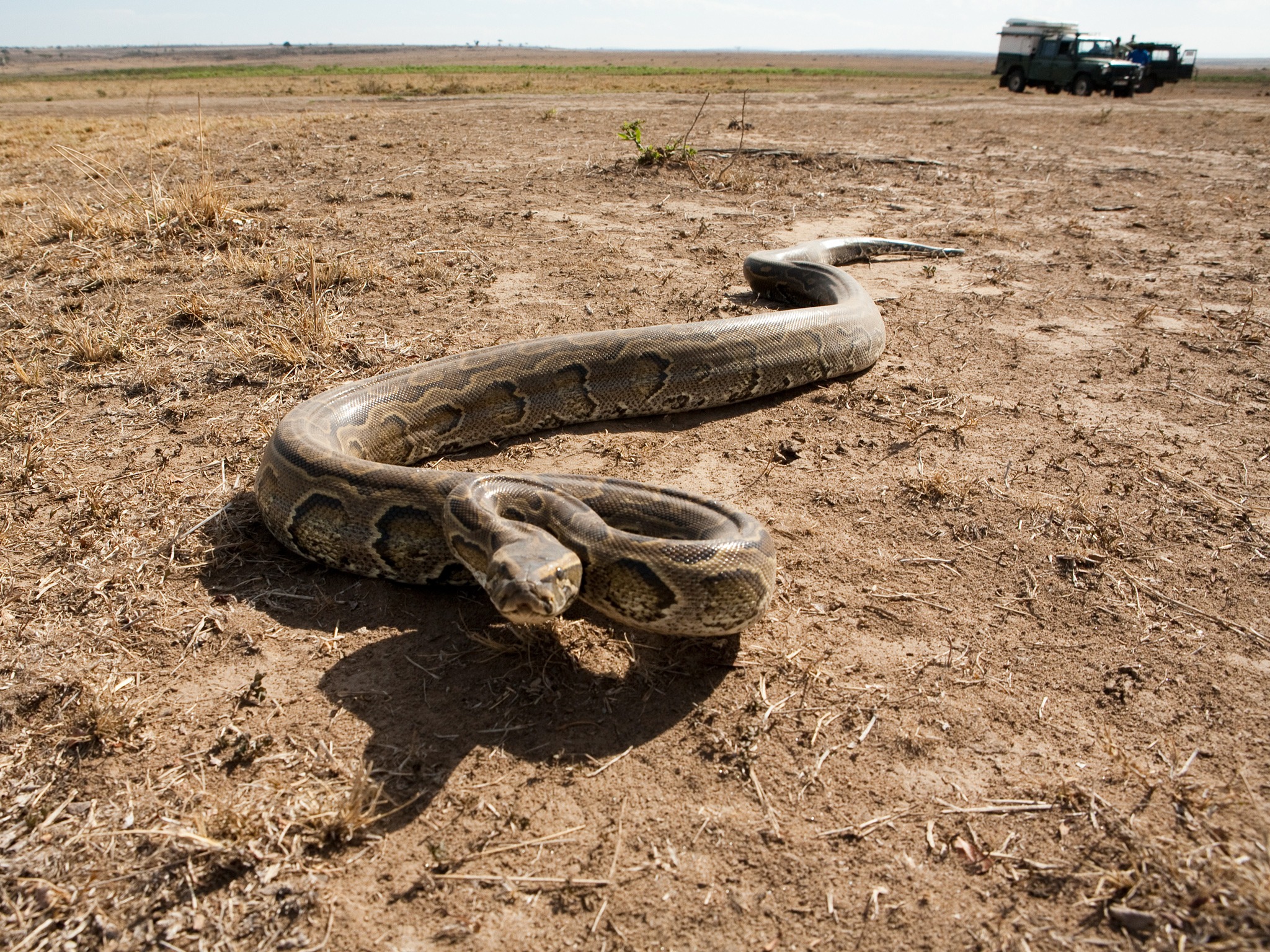
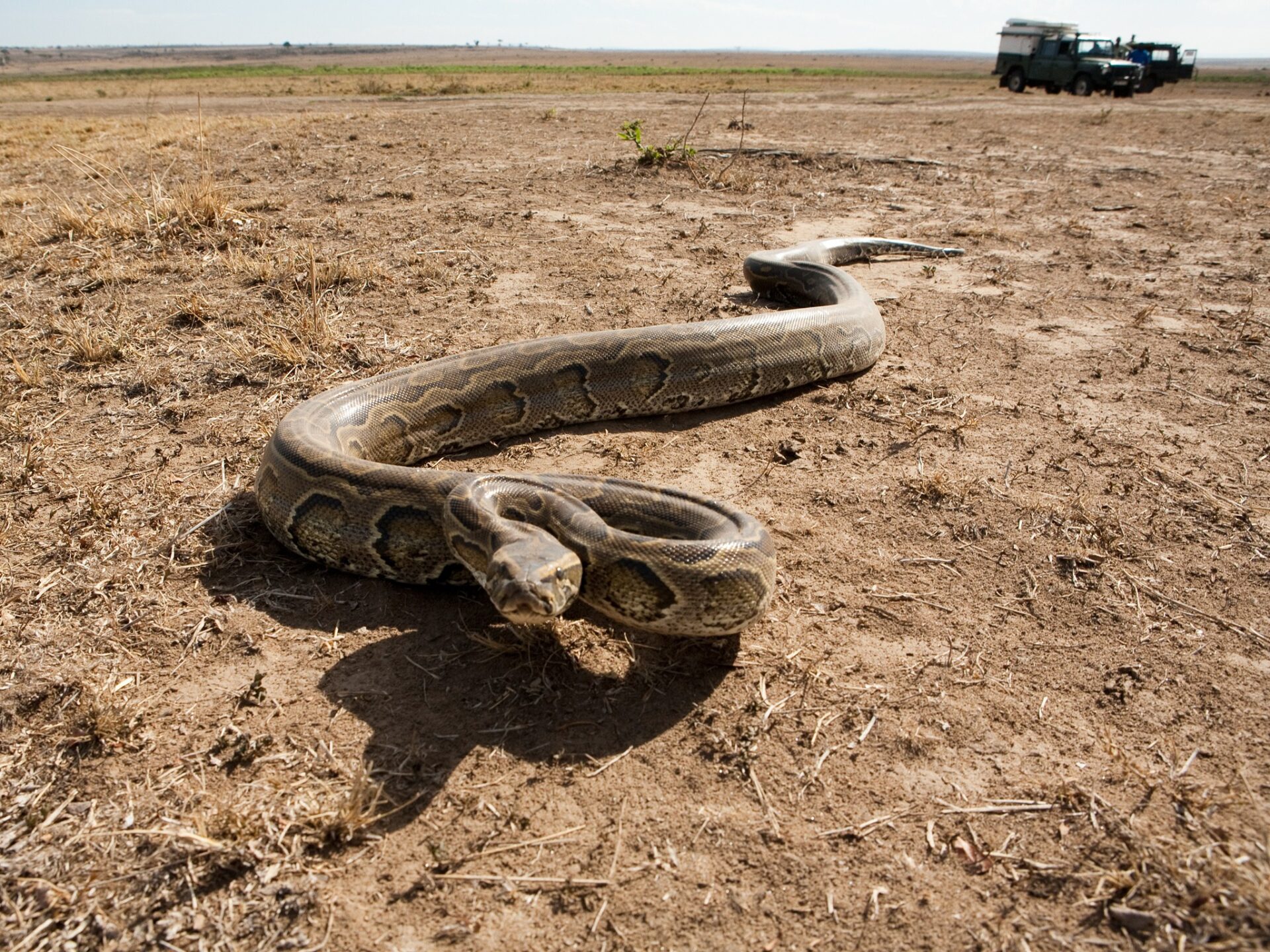
Grey, brown and bronze: a canvas of a unique kind, irregular spots blotched all over, and a triangular shaped head. One of the more distinctive features is the set of sub-ocular marks under its eyes.
An African Rock Python is both fascinating as it is deadly.
As the name suggests, this snake is indigenous to Africa and is one of two subspecies of the Rock Python. The second being the Southern Africa Rock Python found in some parts of Tanzania and in the southern region of our continent.
The automatic assumption when it comes to these scaly creatures is that one bite is all it takes to kill any person or animal, but while most snakes are venomous, the African Rock Python is different. This reptile is so long and muscular, it kills through constriction. It will wrap itself around its prey until the prey can no longer breathe – death by cardiac arrest. Its strength is evident through its ability to kill animals three times its size. However, the most common kills by the python include bushbucks, antelopes, birds, and crocodiles. The python waits underwater for the herbivores to approach a lake and then it strikes almost aggressively, swallowing the prey head-first, whole. There are few stories of surviving animals once the rock python ‘attacks’. Large meals are said to take months to digest.
While that is common for the adult rock pythons, the smaller ones feed on rodents and birds that are easy to digest. The female rock pythons lay up to 100 eggs, which they safely keep in an abandoned cave against other animals including their own kind. The snake’s length helps protect its young ones even after they hatch for up to two weeks.
This wildlife species is also particular in that during the dry season, the animal is mostly dormant.
Some African Rock Pythons have been spotted around Lake Baringo.

The story of the Wildebeest
#KeWildlife - Story 9
Every year, between May and July, the plains of Kenya are transformed in a wondrous way. We could credit this amazing phenomenon to our geographical location - we got lucky and the world travels to our country to experience this first hand.
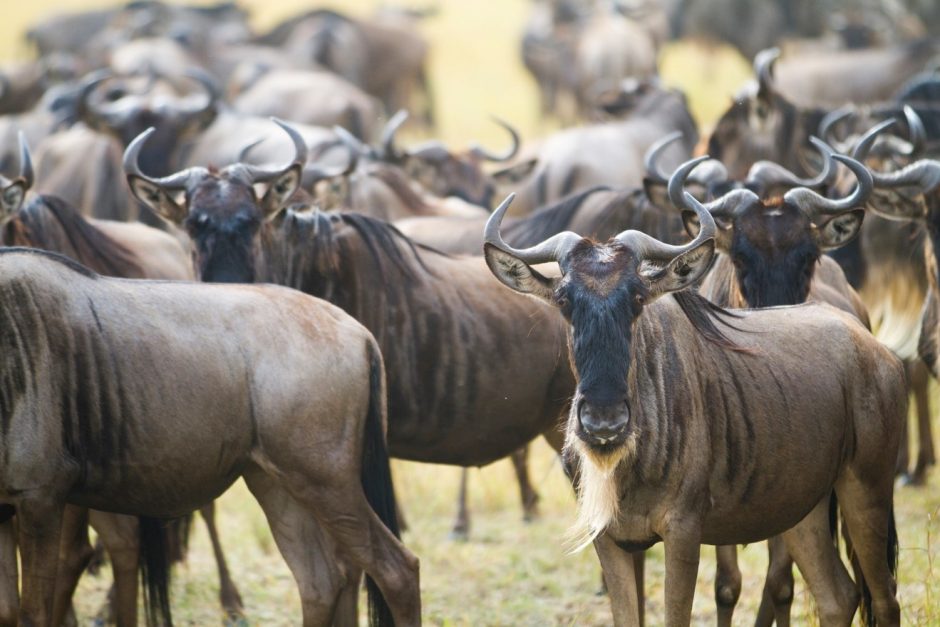
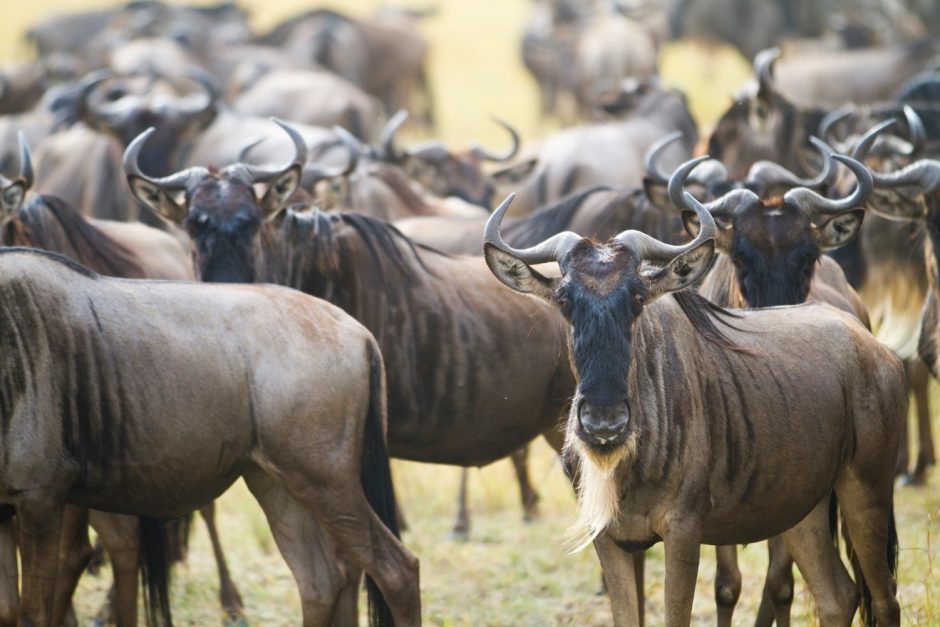
Visualise a great herd, thousands moving together as one from the Serengeti plains in Tanzania to the Maasai Mara in Kenya.
The wildebeest is one of the antelope species, well known for their dark coat and odd humpbacked appearance.
Grassy Savanna’s and open plains are the every day habitat for this group. However, the prep to migrate is something the herd anticipates every year. Unlike most communities, the gnus - or wildebeests - migration is different. While people would roam in search of greener pasture every year in revered history, these animals only know of two locations: one for the first season and the other for the second season in their animal years. We imagine that before the season dawns, many are prepared to bolt and that could mean survival (for most), and demise for the unlucky. Either way, this is a tradition or instinct that has been followed through since time immemorial.
So when the time comes more than 1.5million wildebeest are in motion in an enormous loop. It’s a run as though being chased by imaginary danger yet danger lies in their path as when the animals cross the watery zones inhabited by Nile crocs.
But not all wildebeests that die fall to the fangs of these predators, the weakest of the group may slow down and thus be trampled on by the rest of the herd. The migration isn’t just a movement to a more relaxed land, it is survival of the fittest. Literally! The unlucky in the water zones contribute to the croc’s luck, serving as the carnivore’s meal of the day. This by far goes to show that although this movement is an anticipated one by the world, it also contributes to the animal kingdom’s food chain.
Speaking of the movement, the herd which includes other herbivores such as zebras, covers approximately 3000 kilometers during the migration. The herd will then move clockwise, back south to the Serengeti and so on.
The migration is a sight to behold and brings lovers of wildlife on safari to the Kenyan-Tanzanian plains. So each year, tourists, journalists, nature gurus and others that look forward to this natural event, journey with the wildebeests in fascination.

The story of the Zebra
#KeWildlife – Story 6

There was a time when there were many donkeys. And when we say many, we mean that after every kilometre you would come across at least fifteen donkeys. These animals were valued by porters who would use their donkeys to carry goods over long distances every day.
Day in and day out, the donkeys toiled, but their owners – the porters – never appreciated them or let them get enough rest.
On one sunny day as a group of donkeys crossed each other’s paths, they stopped to talk.
“I’m very tired from all the work I do,” one donkey said.
“Me too,” said another. “My master never appreciates me.”
“All I want to do is relax and eat the grass without having to work ever again!” said another donkey.
And all the donkeys present agreed that they too wanted to stop working.
“But how can we get to relax when every time a porter sees a donkey, they make us work?” asked the first donkey.
“Maybe we should visit the wise, old man. He might know how to help us.” responded another.
That afternoon, as most of the donkeys were busy at work, two of the donkeys went up a green hill to visit a wise, old man who lived there. The wise, old man was respected because he cared and was kind to every man and animal. The two donkeys explained to the wise, old man their problem and the man listened and sympathized with the donkeys.
He scratched his head and bit his fingernails as he pondered on solution ideas.
Finally, “I have an idea!” the man exclaimed after a while.
“Can you help us?” asked one donkey.
“Yes I can, I’m going to get some of the paint that I have in my house and make you look less of a donkey. But once I paint you, you will never look like a donkey again.”
The donkeys brayed in excitement for they were tired of being donkeys.
The wise, old man brought out two pots of paint; one was filled with black paint and the other had white paint. He began painting the two donkeys, coating them first with the white paint and thereafter incorporating the black in form of stripes that cut through the white.
When he was done, the donkeys looked beautiful!
“You are no longer donkeys, but what shall you call yourselves?” the wise, old man asked when he was through.
The donkeys thought, and so did the old, man. “I have another idea,” said the wise, old man. “I could call you zebras!”
*
When the new zebras returned to their donkey friends, they looked less like donkeys and more like new animals. No porter asked them to work – and when the other donkeys saw this, they scrambled up the hill to the wise, old man’s house asking him to paint them too.
The wise, old man brought out his pots of paint and one by one he painted the donkeys that came. But as the day progressed, more donkeys lined up and he became tired. He started painting slower than when he began. The more donkeys that came, the impatient they got as they stood in line. When a ruffle began in the queue, one of the donkeys stepped too close to the wise, old man’s pot with white paint and the pot broke. The paint spilled all over.
“I have no more white paint!” exclaimed the wise, old man. “You have to go back as you are.”
So the donkeys that had been transformed to zebras remained as beautiful, while the impatient donkeys remained as they were and continued to labour under their porters’ schedules.
Kenya’s beautiful zebras draw in attention from miles away. You can find them grazing and lounging, enjoying the benefits of their beauty at Hell’s Gate National Park, Meru National Park and Amboseli National Park.
The story of the Spotted Hyena
#KeWildlife – Story 3

Crocuta crocuta. The name has a nice ring to it.
If we’re to look into hyena history, this animal is probably the best example of wildlife marked as gluttonous, selfish, and even foolish. The most famous of this species has to be the famous three that were brought to international screens in 1994.
Shenzi, Banzai and Ed.
Do these names ring a bell? Well perhaps you remember their leader Scar? the brother of Mufasa?
But we digress....
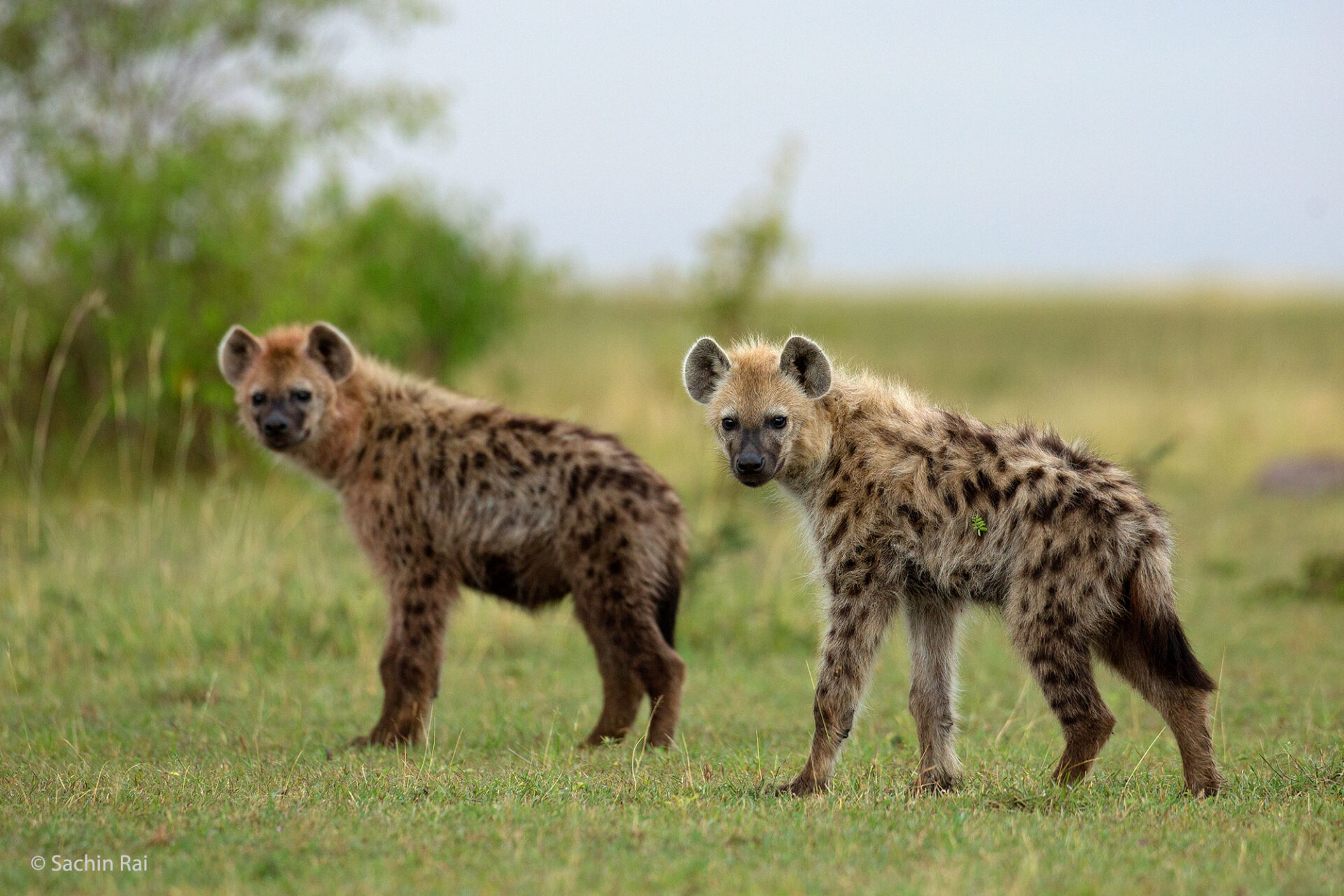
Crocuta crocuta is the other name given to spotted hyenas or laughing hyena or simply fisi for the Swahili speakers. With a figure that’s somewhere between a small bear and a dog, these sandy-grey furred animals are commonly identified through their black spots. They are significantly different from the stripped and brown hyenas. But are similar in that they do bark in form of laughter and can be heard from miles away.
Although spotted hyenas are plenty at night, a fair number can be spotted in the bright of day. A fascinating aspect about these animals is they are one of the most formidable and well-organized predators within the animal kingdom. They hunt in teams to capture larger animals such as wildebeests and gazelles. They are responsible for scouting (and killing) 95% of their meals and when confronted by other predators, they ferociously fight back. This is contrary to stripped and brown hyenas that feign death when found in a similar situation.
The spotted hyena’s pack is led by a female hyena. The females are larger than the males, more aggressive and thus, dominant. The largeness of their hearts allows sufficient oxygen flow and is the result of their ability to endure a hunt for several hours. As for stumbling upon abandoned carcasses, these animals can smell the decaying flesh of an animal from as far as four kilometres away. If the supply is in plenty, a single hyena can eat even 15 kilograms of meat.
Fisis live in clans and mark their territories through droppings or substances secreted from their anal glands but the spotted hyena’s display much communism in that they live in groups atop high lands where they can easily spot other clans that may want to intrude.
There’s a common assumption that the reason humans despise hyena’s so much is because of their recurring habit of trespassing into human homesteads to kill and carry away the domestic animals... but hyena’s got to eat right?
It’s always thrilling seeing the crocuta crocuta roaming around or possibly in action. Locally, these carnivores can be found at the Aberdare National Park, Tsavo West National Park and Nairobi National Park.
The story of the Bushbuck
Have you ever heard of the antelope species Tragelaphus scriptus? Or lets throw down a bigger challenge...can you say Tragelaphus scriptus?!
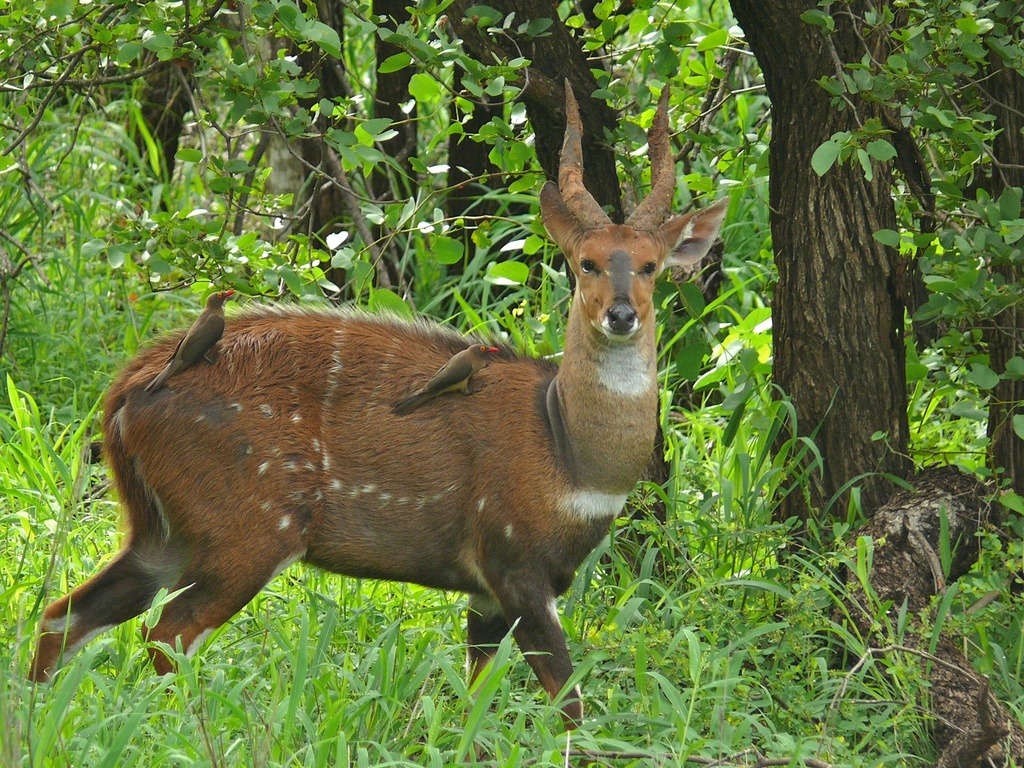
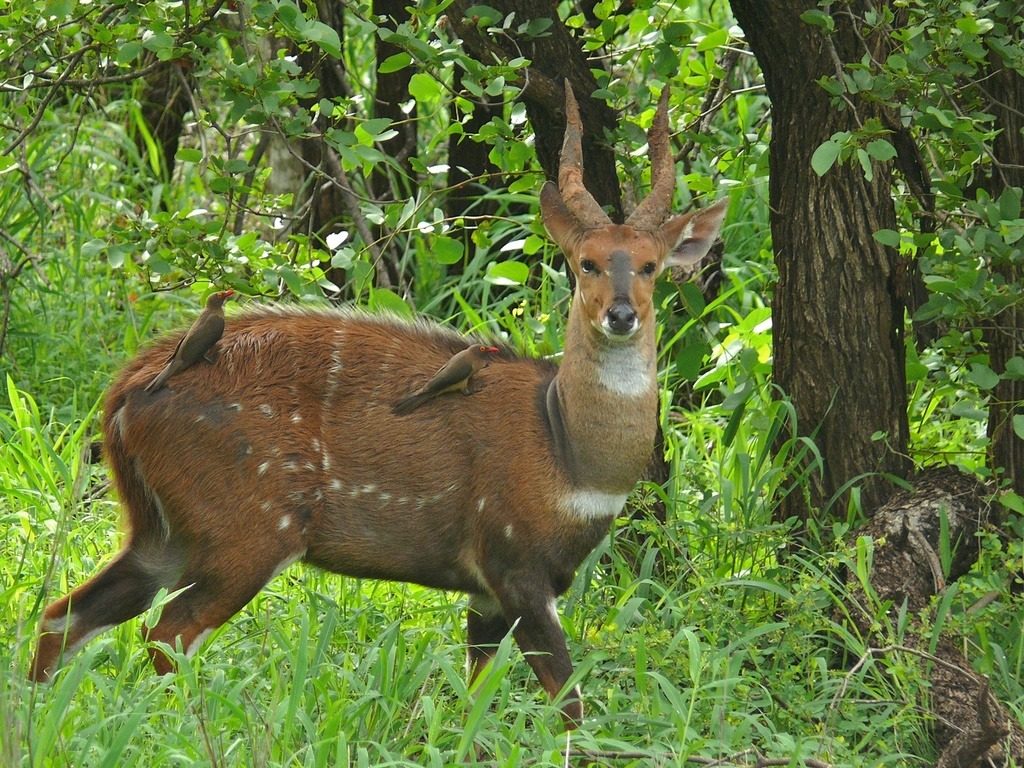
With dark brown fur the male Bushbuck exudes confidence. The female Bushback on the other hand boasts of a lighter brown coat, but shares one aspect of her outward appearance with her male counterpart; they have white dots along their sides that tread in no specific pattern. If colour isn’t the easiest way for an observer to identify the gender of this African mammal, perhaps the male Bushback’s horns provide more clarity. All in all, this mammal is a beatiful sight to behold!
Also called the Imbabala, from the Bovidae family we have to agree that Bushback is a more matter of fact if not really cool name. The name is also synonymous with the animal’s whereabouts – the bush. Did you know this antelope species can only be found in Kenya and 11 other African states? Goes to show that we are indeed a land of hidden gems in form of wildlife.
If you’re looking to spot a Bushback on a safari, you need to keep a keen eye out because these animals are known for their shy nature and they tend to make good use of thickets and within forests. Naturally nocturnal, these animals are known to take advantage of the darkness when they are least likely to be disturbed. In the nightime however, they roam freely and even close in on human settlements which we believe is their way of playing hide and seek with us.
But what’s most striking about this mammal is its solitary nature. Nature’s true introvert.. Bushbacks do not move around in pairs or as herds. For this reason, male and female Bushbacks only come together for the purpose of reproduction and thereafter go their separate ways after a few hours. If the female does get pregnant, the gestation period lasts approximately six months and when her calf is born, she goes to great lengths to ensure its safety against predators by cleaning and hiding it. Although it isn’t known when mother and calf go separate ways, the Bushback’s overall lifespan estimates to 12 years.
Looking to spot this #KeWildlife on a future safari? They can be found at The Aberdare National Park, Ol Donyo Sabuk National Park, Chyulu Hills National Park and Mount Kenya National Park.